Spinal Injury – when to move and when not to!
Latest update for First Aid Management of Suspected Spinal Injury from ANZCOR (all below information has been obtained from ANZCOR website) 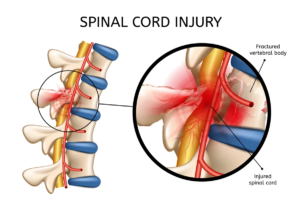
The Australian and New Zealand Committee on Resuscitation (ANZCOR) makes the following recommendations in managing those who have, or may have, a spinal injury [all Good Practice Statements]:
1. ANZCOR recommends rescuers perform cardiopulmonary resuscitation (CPR) for those who are unresponsive and not breathing normally (ANZCOR Guideline 8). This should continue until ambulance or rescue personnel take over.
2. ANZCOR recommends that manual inline restriction of motion of the spine be undertaken wherever practicable for possible spinal injury.
3. ANZCOR recommends that a soft cervical collar only be used to indicate that there is a possibility of spinal injury, and this provides less restriction of motion than manual inline restriction of motion.
4. ANZCOR recommends that semi-rigid collars be used if manual spinal motion restriction is impossible, and only for extrication/transport for the shortest time possible by providers trained and equipped to use these devices. Appropriate circumstances may include extrication from a mountain.
5. ANZCOR recommends that long back boards (spinal boards, including proprietary scoops) only be used to move persons provided that this does not significantly slow moving the person and rescuer from danger and only for the time to move the person
6. ANZCOR notes that head blocks that restrict motion of the head more than the body and frequently increase motion of the cervical spine when the body moves, with the risk of shearing force on the spine, should not be used.
7. ANZCOR recommends that first aid providers do not rely on spinal motion restriction devices to prevent significant motion of the cervical spine, particularly in the unconscious person. Manual inline restriction of motion from a neutral position should be used wherever possible.
Recognize a Spinal Injury:
Symptoms of spinal injury include:
· pain in the injured region
· tingling, numbness in the limbs and area below the injury
· weakness or inability to move the limbs (paralysis)
· nausea
· headache or dizziness
· altered or absent skin sensation.
Signs of spinal injury include:
· head or neck in an abnormal position
· signs of an associated head injury
· altered conscious state
· breathing difficulties
· cold and clammy skin
· change in muscle tone, either flaccid or stiff
· loss of function in limbs
· loss of bladder or bowel control
· priapism (erection in males).
Management
The Conscious Person
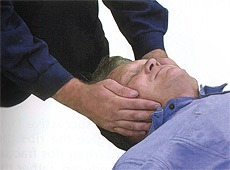
Tell the person to remain still, but do not physically restrain if uncooperative. Those with significant spinal pain will likely have muscle spasm, which splints their injury. Keep the person comfortable until help arrives.
If it is necessary to move the person from danger (e.g. out of the water, off a road), care must be taken to support the injured area and minimise motion of the spine in any direction.
The Unconscious Person
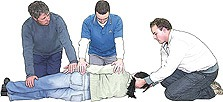
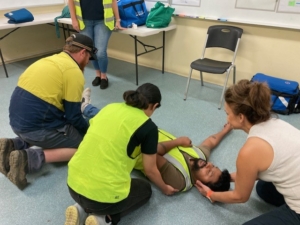
Airway management takes precedence over any suspected spinal injury. It is acceptable to gently move the head into a neutral position to obtain a clear airway. If the person is breathing but remains unconscious, ANZCOR suggests that they be placed in the recovery position (refer to ANZCOR Guideline 3) .
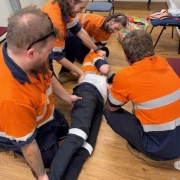
The person should be handled gently with no twisting. Aim to maintain spinal alignment of the head and neck with the torso, both during the turn and afterwards (Spinal Roll). In persons needing airway opening, use manoeuvres which are least likely to result in motion of the cervical spine. Jaw thrust and chin lift should be tried before head tilt.