



Latest update for First Aid Management of Suspected Spinal Injury from ANZCOR (all below information has been obtained from ANZCOR website) 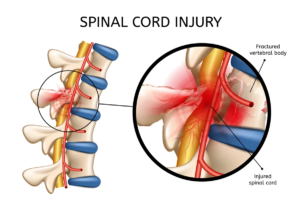
The Australian and New Zealand Committee on Resuscitation (ANZCOR) makes the following recommendations in managing those who have, or may have, a spinal injury [all Good Practice Statements]:
1. ANZCOR recommends rescuers perform cardiopulmonary resuscitation (CPR) for those who are unresponsive and not breathing normally (ANZCOR Guideline 8). This should continue until ambulance or rescue personnel take over.
2. ANZCOR recommends that manual inline restriction of motion of the spine be undertaken wherever practicable for possible spinal injury.
3. ANZCOR recommends that a soft cervical collar only be used to indicate that there is a possibility of spinal injury, and this provides less restriction of motion than manual inline restriction of motion.
4. ANZCOR recommends that semi-rigid collars be used if manual spinal motion restriction is impossible, and only for extrication/transport for the shortest time possible by providers trained and equipped to use these devices. Appropriate circumstances may include extrication from a mountain.
5. ANZCOR recommends that long back boards (spinal boards, including proprietary scoops) only be used to move persons provided that this does not significantly slow moving the person and rescuer from danger and only for the time to move the person
6. ANZCOR notes that head blocks that restrict motion of the head more than the body and frequently increase motion of the cervical spine when the body moves, with the risk of shearing force on the spine, should not be used.
7. ANZCOR recommends that first aid providers do not rely on spinal motion restriction devices to prevent significant motion of the cervical spine, particularly in the unconscious person. Manual inline restriction of motion from a neutral position should be used wherever possible.
Recognize a Spinal Injury:
Symptoms of spinal injury include:
· pain in the injured region
· tingling, numbness in the limbs and area below the injury
· weakness or inability to move the limbs (paralysis)
· nausea
· headache or dizziness
· altered or absent skin sensation.
Signs of spinal injury include:
· head or neck in an abnormal position
· signs of an associated head injury
· altered conscious state
· breathing difficulties
· cold and clammy skin
· change in muscle tone, either flaccid or stiff
· loss of function in limbs
· loss of bladder or bowel control
· priapism (erection in males).
Management
The Conscious Person
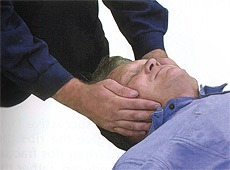
Tell the person to remain still, but do not physically restrain if uncooperative. Those with significant spinal pain will likely have muscle spasm, which splints their injury. Keep the person comfortable until help arrives.
If it is necessary to move the person from danger (e.g. out of the water, off a road), care must be taken to support the injured area and minimise motion of the spine in any direction.
The Unconscious Person
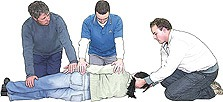
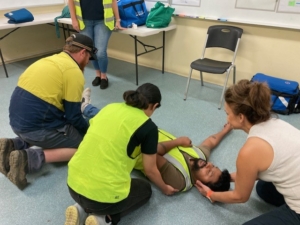
Airway management takes precedence over any suspected spinal injury. It is acceptable to gently move the head into a neutral position to obtain a clear airway. If the person is breathing but remains unconscious, ANZCOR suggests that they be placed in the recovery position (refer to ANZCOR Guideline 3) .
The person should be handled gently with no twisting. Aim to maintain spinal alignment of the head and neck with the torso, both during the turn and afterwards (Spinal Roll). In persons needing airway opening, use manoeuvres which are least likely to result in motion of the cervical spine. Jaw thrust and chin lift should be tried before head tilt.

Australia’s vocational education sector is stepping into a new chapter with the introduction of the 2025 Standards for Registered Training Organisations (RTOs), effective from 1 July 2025. These reforms aim to elevate the quality, integrity, and flexibility of training delivery across the country.
The new standards place a strong emphasis on student support and informed decision-making—starting well before enrolment:
These changes are designed to reduce dropout rates, improve student outcomes, and foster trust in the VET system. Whether you’re a student, trainer, or provider, the 2025 Standards signal a shift toward quality over quantity—where every enrolment is backed by genuine readiness and support.
Managing a Casualty in Shock Following Injury
Shock, is a life-threatening condition that occurs when the body is not getting enough blood flow, depriving vital organs of oxygen. It often results from trauma, significant blood loss, burns, severe infections, or allergic reactions. Recognizing and treating shock rapidly can mean the difference between life and death. When a casualty develops shock after an injury, prompt and effective intervention is essential. This guide provides a thorough approach to recognizing, treating, and supporting a casualty who is experiencing shock.
Shock is a critical failure of the circulatory system, leading to inadequate delivery of oxygen and nutrients to the tissues. It is not simply a psychological response or emotional upset—it is a physical crisis that requires immediate action. There are several types of shock, including hypovolemic (due to blood loss), cardiogenic (due to heart problems), septic (due to severe infection), and anaphylactic (due to severe allergic reaction). Injuries most commonly cause hypovolemic (from blood loss or fluid loss) and sometimes neurogenic shock (from spinal injury).
Early recognition is crucial. The sooner treatment begins, the better the chance of survival. Look for these key signs and symptoms:
As shock progresses, the casualty may become unconscious. If shock is not treated, it can lead to organ failure and death.
When you suspect someone is in shock, your priorities are:
Time is of the essence. As soon as you suspect shock, dial emergency services. Give them clear information about the casualty’s condition, location, and details of the injury.
Help the casualty to lie flat on their back fi conscious and make comfortable.
If the casualty is bleeding:
Make sure the airway is open:
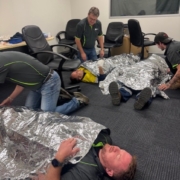
People in shock are very vulnerable to cold. Cover them with a blanket, coat, or any available covering to keep them warm, but avoid overheating. If outside, protect them from wind, rain, or snow. However, do not allow them to eat or drink, especially if surgery may be needed.
Stay with the casualty and observe their condition closely. Talk to them calmly and reassuringly, even if they seem confused or agitated. Be ready to perform CPR if they stop breathing and become unconscious.
Do not give the casualty anything to eat or drink—even if they are thirsty. Food and fluids can complicate medical treatment, especially if surgery is required. If the casualty asks for water, moisten their lips with a damp cloth.
If safe and appropriate, loosen tight clothing to improve circulation and comfort.
Keep the casualty as still as possible. Excessive movement can worsen injuries or increase blood loss.
Remain calm to help the casualty to remain calm and provide reassurance. Calmly encourage the casualty to relax and breathe slowly. Stay alert for any changes in their condition.
Spinal Injuries:
If you suspect a spinal injury, do not move the casualty’s head, neck, or back unless absolutely necessary for safety or to maintain an airway if unconscious and breathing. Do not elevate the legs. Call for professional help immediately.
Pregnancy:
For a pregnant casualty, avoid the shock position. Instead, place them on their left side to minimize pressure on major blood vessels.
If at any point the casualty becomes unconscious and stops breathing, begin CPR immediately and continue until help arrives. Attach a Defibrillator if available and follow the voice prompts.
While not always possible to prevent, quick recognition and treatment of injury, bleeding, or other causes can minimise the risk of shock developing. Educate yourself and others in basic first aid to be prepared for emergencies. It is always recommended to attend a First Aid Course under instruction of trained professionals to practice vital first aid skills.
Treating shock in an injured casualty is about rapid assessment, reassurance, and careful action. Your ability to stay calm, control bleeding, and keep the casualty warm can save a life. Remember, always seek professional medical help as soon as possible. First aid is not a substitute for proper medical care but is often the vital first step toward recovery.

When an emergency happens, every second counts. Whether you’re at home, at work, or out and about, having quick access to reliable first aid information can make all the difference. While formal first aid training is essential, free mobile apps can be great tools for refreshing your knowledge and guiding you through emergency situations.
Here’s a roundup of some of the top free first aid apps that you can download today:
Available from: App Store & Google Play
Why we love it:
✅ Best for: General public, students, travellers
Available from: App Store & Google Play
Why we love it:
✅ Best for: Workplaces, parents, and first-time learners
Available from: App Store & Google Play
Why we love it:
✅ Best for: Travellers, multilingual users, or people moving between countries
Available from: App Store & Google Play
Why we love it:
✅ Best for: Everyone in Australia—especially in regional/remote areas
These apps are completely free and take just minutes to download—but they could help you save a life. Remember, there’s no substitute for hands-on training. If you’re ready to build real confidence in a crisis, enrol in a nationally recognised First Aid and CPR course today.


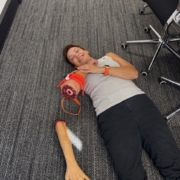
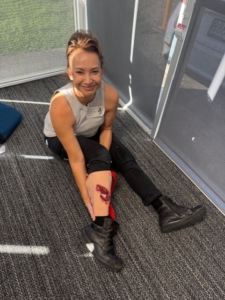
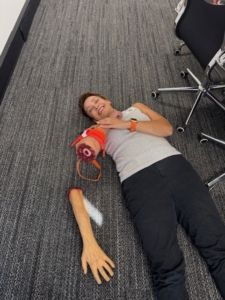
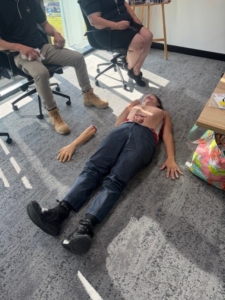
How much fun do you have at your first aid courses? Does your trainer just read from a PowerPoint most of the time? Does your trainer use props for visual effects?
One of the most effective ways to learn first aid skills is by doing close to real life scenarios and have fun at the same time.
Learning by doing, often referred to as experiential learning, has several benefits, especially in a practical subject like first aid:
Enhanced Engagement: Hands-on training keeps participants more engaged and interested in learning the content.
Better Retention: Practical application helps reinforce the knowledge that is learnt, making it easier to remember and recall information in real-life situations.
Skill Development: Practicing skills with props and visual effects allows learners to gain confidence and proficiency, which is crucial in emergency situations.
Immediate Feedback: Participants can receive instant feedback from their instructors, allowing them to correct mistakes in real-time and improve their techniques.
Realism: The use of visual effects and props simulates real-life scenarios, preparing learners to respond effectively when faced with actual emergencies that may occur at the workplace or home.
Overall, incorporating these elements leads to a more effective and impactful learning experience in first aid training. It is also important that you have fun while you learn! I certainly do as the trainer for First Aid Action RTO31668!
Contact us now and let Luella train your staff and prepare them for emergencies. Read our 320 five star reviews to see what her clients think about her training.
Phone: 07) 3901 0599
Email: info@firstaidaction.qld.edu.au
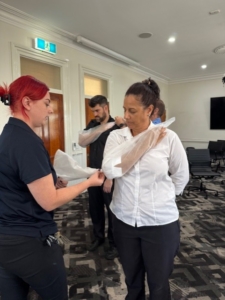
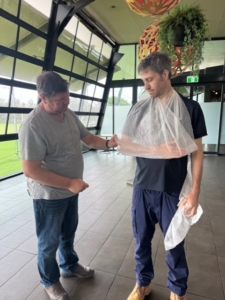
The versatility of the triangular bandage lies in its ability to adapt to a wide range of situations. Its shape and size allow it to be folded, tied, or wrapped in various ways, making it suitable for addressing multiple types of injuries in first aid situations at home or work.
The triangular bandage can be applied in numerous ways during emergencies. Below are some of its most common and practical uses:
One of the most well-known uses of the triangular bandage is as a sling to support an injured arm or shoulder. By folding or tying the bandage, you can create a secure sling that immobilizes the arm, alleviating pain and reducing the risk of further injury. This is particularly helpful for fractures, sprains, or dislocations.
In cases where a limb needs to be immobilized using a splint, the triangular bandage can be used to tie the splint in place securely. Its strength and flexibility make it ideal for ensuring that the splint stays in position, providing stability and protection to the injured area.
For wounds or injuries to the head, the triangular bandage can be wrapped around the scalp to protect the affected area. This application is especially useful for controlling bleeding and preventing contamination of open wounds.
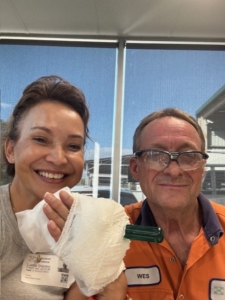
When dealing with large wounds that require coverage, the triangular bandage can be used as a dressing. It provides adequate coverage and can be tied securely to keep the wound protected until professional medical help is available. It can also act as a thick pad to apply pressure to stop bleeding or folded into a donut ring to support impaled objects.
In critical situations where severe bleeding needs to be controlled, the triangular bandage can be folded and used as a makeshift tourniquet. While this should only be done as a last resort and with proper caution, it demonstrates the bandage’s adaptability in life-threatening scenarios.
The triangular bandage can be used to create an eye pad by folding it into a smaller shape. This pad can then be tied around the head to keep the injured eye covered and protected. It can also be used a donut bandage to cover an impalement in the eye.
In situations where additional padding is required, the triangular bandage can be folded into a compact shape and used to cushion injuries. This is particularly helpful when splints or other rigid objects need extra padding to avoid discomfort.
When treating swelling, the triangular bandage can be used to secure cold packs or compresses against the affected area. Its ability to hold these items in place ensures that they stay effective and properly positioned.
Although less common, the triangular bandage can serve as a temporary restraint or binding tool in emergency situations where controlling movement is necessary for safety.
One of the greatest advantages of the triangular bandage is its practicality in remote or outdoor environments. For hikers, campers, or adventure enthusiasts, this lightweight and compact tool can be a lifesaver. Its ability to function as a sling, splint tie, or wound cover makes it indispensable in settings where medical facilities might be far away.
It all starts with an education. Are you ready to take action?


© 2022 First Aid Action. All Rights Reserved. RTO No. 31668